
NEWS
IN BRIEF
If Liberia’s history has demonstrated anything over the years, it […]
SHARE
If Liberia’s history has demonstrated anything over the years, it is that women took the lead when the nation needed a path forward. From the legendary Chief Suah Koko to the thousands of women in white who stood up to end a civil war, female leadership has never been a luxury here; it has been one of survival. By electing Africa’s first woman president, Liberia showed the world what is possible when women take their rightful place at the table. Liberia isn’t just following a trend but is trying to continue this powerful legacy.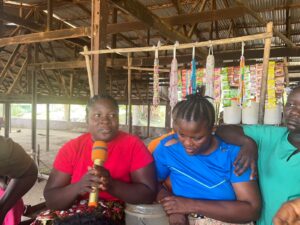
Yet, this history is defined by a powerful paradox. From being the nation that produced Africa’s first female president and a Nobel Peace Prize-winning women’s movement, Liberia continues to struggle with a concrete ceiling in the halls of power, the Legislature. According to the World Bank Gender Data Portal, women currently hold only 11% of the seats in the National Legislature, a figure that has remained largely stagnant for over a decade. This puts Liberia at a discouraging 161st in the world for women’s parliamentary representation, well below the sub-Saharan African average of 27%. While our history celebrates the Iron Lady (former President Ellen Johnson Sirleaf), high-level success has not yet translated into an inclusive democracy where women have an equal seat at the legislative table.
In December 2025, the “Increasing Women’s Participation in Leadership and Governance” project in Bomi, Gbarpolu, and Grand Cape Mount Counties, implemented by Accountability Lab Liberia and partners with funding from the National Endowment for Democracy (NED), was launched to support a set of activities aimed at ensuring that the next generation of women in those parts of Liberia are not just bystanders but active participants in decision-making at the sub-national and national levels.
Since the launch of the project across the Western Cluster, Accountability Lab Liberia, along with three women-led local community-based organizations serving as partners and mentors in the three counties, has carried out a series of leadership awareness activities ranging from town hall meetings and high school-based engagements to activities in the markets, with the latest being the Market Lecture Series, an innovative approach to reaching market women where they are.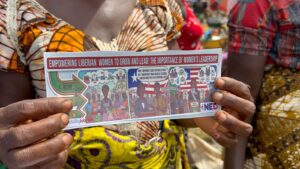
Through this NED Women Project and activities, Accountability Lab Liberia has started witnessing a gradual transformation. The women are not only attending the town hall meetings or gathering around for the market lectures; they now seem like inspired citizens taking back their civic power, and that was seen at different market meetings. The message was the same for the counties: the future of Liberia’s governance and integrity depends on the inclusion of women who hold our communities together.
Bomi
In Bomi, the conversation centered on access. For many women in Tubmanburg and Gbah, the barrier hasn’t been women who lack the willingness to step up and participate or take on leadership roles, but a lack of information. Tutu Dedeh Mulbah captures the importance of the market lecture series to her:
“This is the first time people are coming with this type of information to us because most times we are not allowed in rooms of leadership. This information is helping us to push ourselves to get involved.”
Korpo Johnson took it a step further, highlighting the feedback loop of political power and the strength in numbers:
“As women, we have political power not just to vote but also to support each other because we are in numbers. Even though we have the power, we are suffering from the feedback of that power when we vote for these politicians. Now, we need to support more women.”
Cape Mount
As we moved toward the coast in Grand Cape Mount, the impact was seen in how women are literally reclaiming their physical presence in the community. Jenneh Zoduah, from Gohn Zoduah, shared:
“Before, when men were gathered, we women would pass behind the houses. If men were somewhere talking, women couldn’t even stand around. But this time around, we are standing and talking for ourselves… Women, you have to talk for yourself!”
Isatta Kromah of Sinje Estate added that this new voice must be backed by independence: “Women need to take their business, agriculture work, and education seriously to help them be financially independent… and support one another for leadership opportunities.”
The Investment in Our Future
Deep in Gbarpolu, the focus shifted to long-term community development. Rose M. Harpai, Advisor for the Bopolu Market, noted the shift in consciousness:
“Before this session, many of us did not fully understand the power of our vote. Now we know that our voices matter, and we are determined to protect our votes by voting wisely.”
Kharfee B. Fofana, County Gender Coordinator, summarized the mission: “Empowering women economically and educating our girls is not just a family matter; it is an investment in the future leadership and development of our entire community.”
Sustainability
As the civic space in Liberia continues to navigate a challenging period marked by shrinking donor support and limited resources, many grassroots organizations and community leaders are being forced to rethink how they sustain the gains achieved. Despite these constraints, the women participating in the market lectures have demonstrated remarkable resilience and commitment to strengthening civic awareness within their communities. Recognizing the importance of informed and engaged citizens, they have pledged to continue creating spaces for dialogue, learning, and collective action within their safe spaces, ensuring that civic knowledge remains accessible and embedded in the daily lives of women across the three project counties; Bomi, Gbarpolu, and Grand Cape Mount.
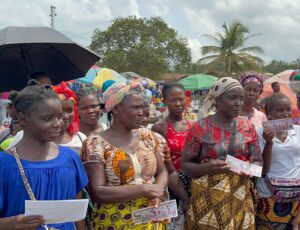
Building on this momentum, Accountability Lab Liberia is committed to supporting the evolution of these market lectures into a sustainable network of active women leaders and community change-makers. Beyond facilitating civic education activities, the project will continue to invest intentionally in the capacity development of women-led civil society organizations that serve as trusted reference points and support systems for women at the county level. This will include mentorship, leadership development, and organizational strengthening opportunities designed to enhance their ability to mobilize communities, advocate for local priorities, and sustain their work beyond the life of the project. Accountability Lab Liberia will also prioritize networking and peer-learning opportunities, fostering stronger connections among women leaders, CSOs, local stakeholders, and development partners. By strengthening both individual leadership and institutional capacity while expanding collaborative networks, the initiative seeks to lay the foundation for a resilient and self-sustaining ecosystem of women-led civic engagement across Liberia.
By: Parnneh T. Mallobe, Communications Officer, Accountability Lab Liberia